
I remember my first impression when I saw the first Breath of the Wild teaser: a beautiful world, but mostly empty.
Years later, and dozens of hours of play time later, that first impression still stands true.
It’s definitely huge, and has some good physics, and some of the most astounding AI reactions—in two word: emergent gameplay—I’ve ever seen in a game.
I could easily say this is probably one of the funniest sandbox ever created, up there with throwing toilets against Zombines with the gravity gun in Half-Life 2.
But what about the rest of the game?
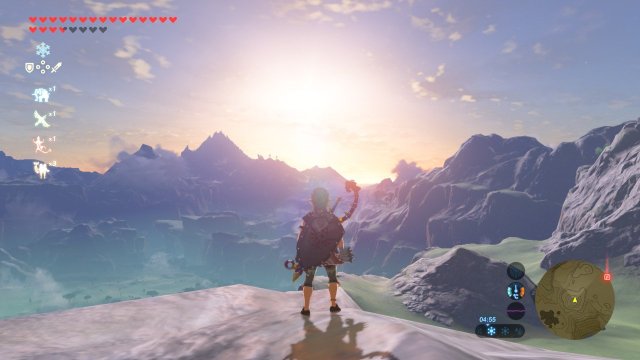
Stripped of its physics engine, Breath of the Wild is not much unlike your average RPG, but admittedly it manages to conceal it under a rather heavy coat of seamlessness.
The simplistic UI, for example, helps distracting the player from the sheer fact that most tasks are nothing more than fetch quests.
Quest givers would say something like: “Find me some Bokoblin nails.”
The lack of a Bokoblin nails counter makes the quest sound like: “That guy needs a bunch of Bokoblin nails, surely for some epic reason! Let’s help them out!” instead of “Ugh, the game is asking me to collect some randomly dropped crap in exchange for some cash,” but in fact they’re exactly the same thing.
One NPC had the nerve to ask me 55 mushrooms of some particular kind. Bugger off you old fart, ain’t nobody got time for that.
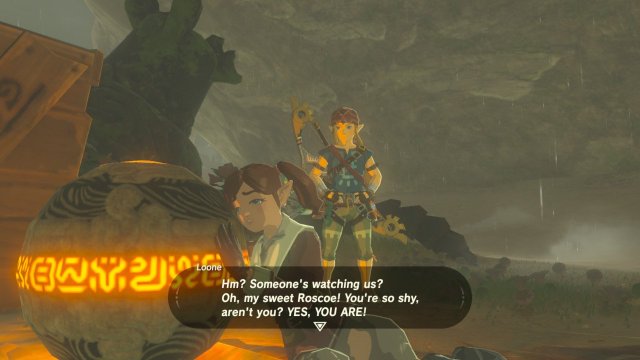
Upgrading armors is yet another example: it isn’t part of the quest log, so it literally can’t be called a “fetch quest”, can it? On the contrary: it’s crafting, and crafting’s cool!
Well yes, it is cool, usually. But in Breath of the Wild it entails wiping out entire species in the pursue of a quite measly defense upgrade—interesting bonuses are only granted at the 2nd of 4 level of upgrade, after that there is virtually no reason to upgrade at all.
And what about those armor pieces that require farming dragons (I’m looking at you, lovely yet worthless Set of the Wild), which is the most unnecessarily time consuming thing you can do in this game?
This is padding. This is filler content.
This is like when Goku goes to the park to eat some cotton candy because the production studio has to output 51 episodes instead of 50.
It would be bashed anywhere, but Zelda has the whole untouchable quality that only the legends (pun intended) can boast.
Let’s talk about the shrines: 20 out of 120 of them are Tests of Strength.
If you’re not familiar with them, they consist in fighting a Guardian, an enemy not even exclusive to these Tests, but that you can commonly find while exploring the overworld.
Guardians are supposed to be among the most dangerous enemies in the game, but once you figure out the trick, every fight with them boils down to waiting for the right chance to pull off that trick.
And yet, you’re basically forced to fight them 20 times—if you want all shrines, it goes without saying—in addition to all the rather frequent times you bump into them outside.
The Tests of Strength aren’t even the only repetition in the game: all enemy bases look pretty much the same, Korok Seeds puzzles have just a handful of different patterns, etc.
My point is: Zelda is capable of loads of great, legit fun; and yet it scatters it in a beautiful but huge, empty, and repetitive world.
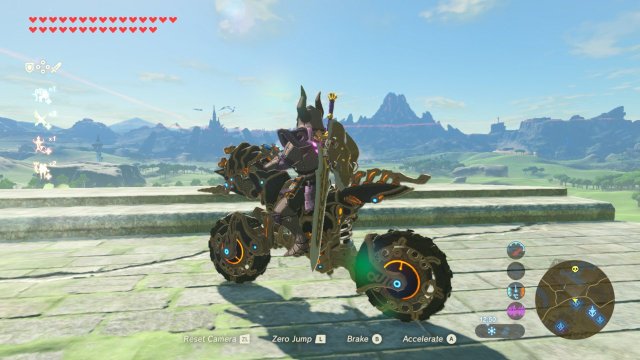
I commend Nintendo for their attempt at giving Zelda an impressive epic scale, but Breath of the Wild is a great example of why, at the end of the day, less would have been more.
On the opposite end of the open world spectrum we find Super Mario Odyssey—even though it could only be considered “open” if the last 25 years of video games never happened.
It is, though, more open than all the previous Mario games, in that you enter a world, and then you’re basically on your own, free to explore it without limits, boundaries, quest lines.
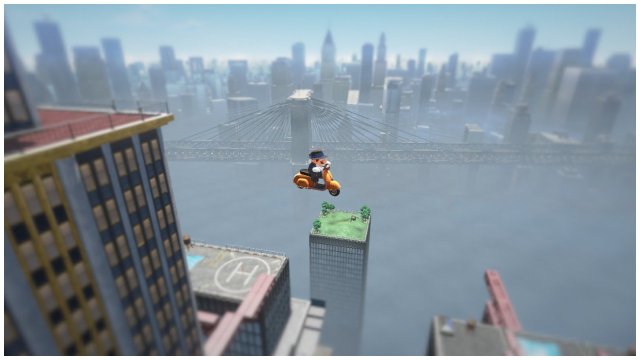
Where Zelda is a sandbox that relies on the gameplay emerging from situations happening thanks to the physics and AI muscles of the game, Mario—excluding some cute details more akin to Easter eggs than actual gameplay elements—doesn’t even pretend.
Mario is a playground for the player skills, but also for the designers and developers creativity.
Players can literally do everything allowed by their joy-cons and their own eye-hand coordination. Designers and developers can do whatever they think fit as well, free of any constraints of realism and cohesion, subtly driving the players efforts toward some pre-established goals.
It’s impressive how seemingly minimal and concealed the designers intervention looks like in Mario.
It’s easy to mistake it for carelessness: they’ve dropped some blocks here and there around the world, then buried some Power Moons under the dirt, and called it a day. Though, it couldn’t be any more different than that.
Every polygon is positioned with the utmost careful precision. When the player finds one of the countless Moons, the reward is not just another item grayed out from the completion checklist: it is an invisible beacon that directs them toward the next Moon.
It’s not dissimilar to a Pollock painting. It can be a sensory overload, infinite cues crying for the viewers attention, provoking their reaction. But when they abandon themselves to its waves, strokes, and blotches, the hidden paths will emerge before their eyes.
Odyssey‘s Moons too lay down a path. Catching one is always a hint that unveils the path to the next. May it be a faint sound that only occur in that exact location, a tiny detail, or an imperceptible pan of the camera.
I ended up struggling to stop each Odyssey session, completely enthralled by its flow.
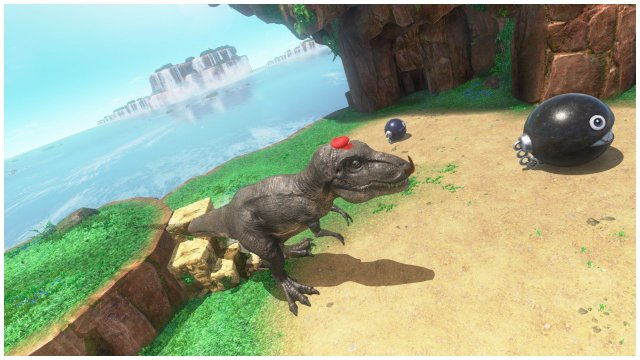
Don’t get me wrong: even if personally I’d appoint Odyssey a perfect score, it’s not a perfect game.
Its ~900 Power Moons are often as repetitive as Zelda‘s ~900 Korok Seeds, and I’ve lost count of the times I’ve butt-stomped shiny spots in the ground.
Odyssey, though, has two levels of enjoyment: there is the sheer, simple fun that all Mario games can rightfully brag about since when Pauline was just a pixelated damsel-in-distress; but there is also the intellectual excitement, elicited by figuring out how Nintendo managed to pull off such a strict hand-holding in such a seamless and subtle way.
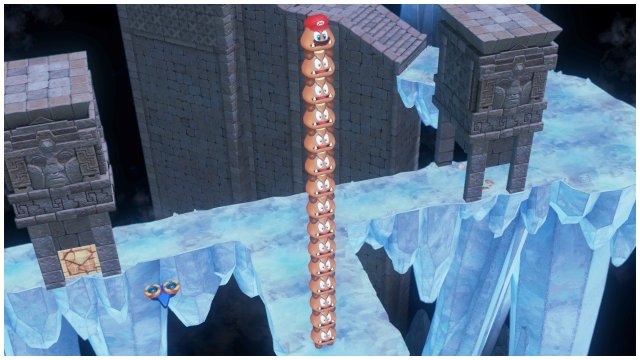
In the end, though, it inevitably comes down to how people like their games.
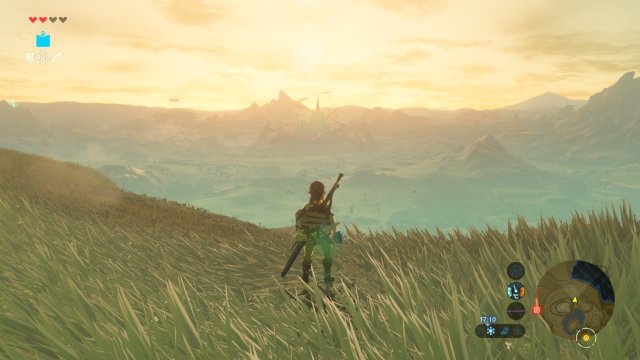
Breath of the Wild drops the player into a big world with flexible and dynamic rules, and tries to interfere as little as possible, leaving most of the fun in the hand of the player themselves, and how they decide to approach the game, and how the AI decides to react to it.
If the experience proves to be sloppy, it’s likely because the player didn’t experiment enough.
Odyssey relies on its unbelievably tight design and on the player abilities rather than on artificial aids: there is no stronger sword and better armor that can help you achieve a Cappy dive jump.
Virtually, the experience just cannot prove to be sloppy. On the other hand, if the player is not good enough—or hasn’t got enough patience to grow good enough—the experience can feel incomplete.
But when (if) you manage to pull off a Cappy dive jump by your own, it’s so much more satisfying than anything you can do in the entirety of Hyrule.
 Copons Blog
One reply on “Battle for the GOTY – Super Mario Odyssey VS The Legend of Zelda: Breath of the Wild”
[…] never matters, though.Years ago I had something to say about the huge but empty Hyrule of The Legend of Zelda: Breath of the Wild, and my opinion […]
LikeLike